
Draft Ready | Part 3: What You Can Actually Control to Improve Your AFL/AFLW Draft Chances.
You've read about how recruiters identify and investigate talent. You know the process, you know the timeline, and you know that consistency over several years matters more than any single game.
But what are they actually looking for when they watch you?
Talent identification is complex - there are multidimensional performance factors that influence draft decisions, and whilst not all of them are within your control, many of them are.

There Are MANY Variables That Influence a Recruiter's Draft Decision.
Some of these variables can be directly influenced by you - if you put in the right work, you can improve them to increase your draft chances. These are your controllable variables, and they span across physical, physiological, technical, tactical, psychological and sociological dimensions [1].
There are also uncontrollable variables - things that impact selection decisions that are totally out of your hands. We'll cover those in Part 4 (coming soon). For now, let's focus on what you can do something about.
We’ve reviewed the literature and collated our experience working with recruiters to put together this guide for you.
1. The Physical + Physiological — What the Data Says (and Doesn't Say)
Physical and physiological attributes are one of the most reported on qualities of prospective talent, alongside technical ability – and with good reason, young footballers who do not have the physical attributes to make it in the AFL/AFLW won’t get drafted; that’s not to say that they cannot build and develop these attributes.
“You’ve got to have the right physical attributes. There's plenty of kids running around the South Australian National Football League and the West Australian Football League and the Victorian Youth state league that are multiple possession winners and all these sorts of things, but they just physically won't have the attributes to be able to get to the next level” - Recruiter 8 [2]
This is supported not only by recruiter anecdotes, but also by data; a recent longitudinal study examining AFL Draft Combine performance data found that players selected to attend the combine are of a “homogenous body type group” [3]. Whilst additional (less recent) research also dictated that players selected in the national draft possess higher levels of running endurance (i.e., 20m multistage fitness test) and are faster (i.e., 20m sprint time) compared to non-selected players [4].
But here's what's important to understand: physical and physiological attributes only matter if they positively impact your in-game performance. A 6'3 key forward who can't mark the ball and has a poor vertical leap is significantly less valuable to a recruiter than those numbers suggest on paper.
“I am going with someone who plays quick, not tests quick” - Recruiter 10 [2]
This reinforces our next point – results from the Draft Combine are used as an additional data set - but they are not the be-all-end-all. The Combine consists of a variety of isolated physical and anthropometric tests, and whilst capturing this data is useful for clubs to have, it cannot compare to true match performance. In fact, research has suggested that data collected at the AFL draft combine is a poor predictor of career performance [2].
“the kicking test at the AFL combine would have no influence at all on our decision making” [1]
So if the Combine data isn't highly influential, what else are recruiters paying attention to? Often, it's less about the specific result and more about the intent and desire behind it.
"When they're doing the two-kilometre time trial, how did they go about it? Do they get up the front and have a real crack at it, or do they immediately drop to the back and cruise around and then sprint the last 200 meters?" — Recruiter 3 [2]
What this means for you: Yes, you need to work hard to get your body to an elite standard - but no single sprint test or 2km time trial will make or break your draft hopes. Use this knowledge to reflect on your physical attributes, talk to your coaches and high-performance staff about how to improve them, and focus on how those attributes translate onto the field. If you don't have someone guiding that process, reach out to us.
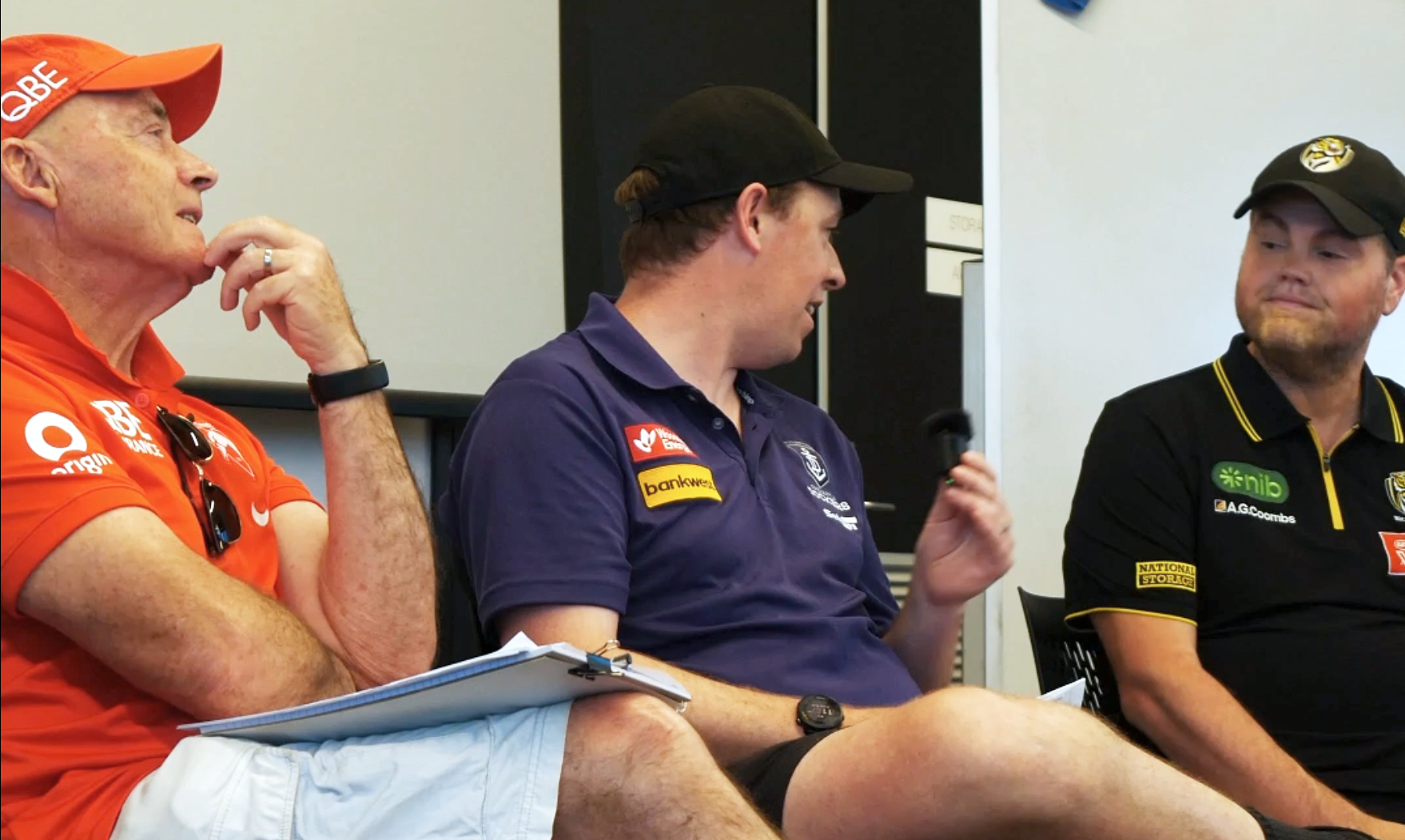
2 . Technical + Tactical - Your In-Game Performance Is Everything
Now you know that recruiters want to see physical and physiological attributes that can compete at the elite level and that those attributes need to show up in on-field performance. This is where the technical and tactical component of your game comes in.
Recruiters consistently identify that players categorised as 'talented' possess superior in-game technical abilities [1]. Players with elite fundamentals and composure under pressure significantly improve their draft prospects, so work on them as often as you can, and work on them with intent. We touched on this in a past blog post: ‘How to Make a Talent League Squad’
Recruiters assess all the following technical components (and more):
Kicking
Ball Winning
Marking
Ground Balls
Defensive Skills
Positioning
Goal Kicking
Use of the opposite side of the body
By developing your technical skills, you simply become a more effective footballer — and that stands out. Research supports this too, with match performance outcomes such as contested possessions and delivering the ball into the forward 50 identified as key differentiators between drafted and non-drafted players [5].
"Yeah, we place enormous emphasis on kicking, but that doesn't mean they have to be a great kick right now." [1]
"Kicking is one that stands out a lot more because it's a little bit harder to master — and if you're a poor kicker, there's not much you can do about it sometimes. So kicking is critical." [1]
From a tactical perspective, recruiters are looking for smart, hard-working footballers who are clean and decisive under pressure.
Can you read the flight of the ball? Can you read the play, intercept the ball, break free of your opponent, decide how to dispose of the ball AND do it effectively all in a split second? Can you handle the randomness of the game and redirect it to benefit your team? If you CAN do all these things… do you do it in games?
Although some recruiters have acknowledged that players could be monitored earlier in their development, it is generally accepted that it is not the best use of their finite resources.
"The under-16 national championships is the first main competition where you just see the best (players compete against each other). It is our first real look at a lot of the talent." [1]
Recruiters are watching for these in-game habits, and they prioritise watching draft prospects live – regardless of location or grade of football they are playing in, if there is a draft prospect on their list, they want to watch them play live [2]. Watching players live provides recruiters with a holistic understanding of a players in-game performance, it shows them their on- and off-the-ball game behaviours all of which can dictate a players technical and tactical capabilities [2].
For example, a tactical small forward knows to position themselves at the foot of their key forward, they know that they have to run and chase every loose ball and apply pressure at every opportunity – none of these efforts are rewarded statistically, and they may easily be missed in the vision, if a recruiter doesn’t watch this small forward live, they would likely develop an incorrect tactical profile for this player.
"You need to see them live — watching them live will give you a lot of that attitudinal stuff. Do they chase? Do they harass? How do they go when things aren't going well? What's their mental state if they stuff up? Do they get on with the game quickly?" — Recruiter 2 [2]
What this means for you: Work on your technical skills under pressure and in game-like scenarios as much as possible, and become a student of the game. Learn what your position demands, ask your coaches how you can better play your role, and identify the tactical capabilities you need to sharpen.
And don't forget - recruiters are watching more than just your ball use. Your behaviour, effort, intent, and even what you say on the field is all observed and factored into your player profile.
If you'd like objective feedback on your technical skills or role-specific guidance, reach out to us. We'll connect you with our program which includes a thorough skill assessment and provide the kind of targeted advice that helps you stand out when it counts.
3 . Psychological + Sociological — The Interview + Reference Check Process
You might have seen it covered in the media - draft prospects being asked unusual questions during club interviews, or stories of recruiters turning up at family homes. There's a reason for all of it.
There has been a significant shift in the importance placed on psychological and sociological assessments in recent years. Whilst past research emphasised technical, tactical, and physical skills as the primary predictors of athlete performance [6][7][8][9], current findings show that recruiters are increasingly prioritising player interviews and psychological assessments [2].
The perceived psychological make-up of an athlete rather than their physical or technical performance alone, has been noted by recruiters as a key non-selection element. Put simply: if recruiters perceive an athlete as not having the psychological strength to make it at an elite level, that alone can be enough reason to pass on them [2].
"Look, why didn't this player make it onto an elite team list? It's very rarely because he wasn't athletic enough or he wasn't talented enough... It purely came down to the mind-set, the character of the player. Not every time, but in the vast majority, this is the case." — Recruiter 12 [2]
Recruiters have highlighted the importance of mental resilience and drive - noting that whilst it's easy for athletes to fixate on getting their technical and physical game perfect, psychological qualities can be just as influential on a selection decision [2].
"If you're splitting hairs between one or the other, for me, it's who's the most driven and the most resilient, because they're the ones who'll make it." — Recruiter 6 [2]
So why do recruiters invest so heavily in building a psychological profile? Because they're trying to determine whether a player can adjust to the demands of a senior professional sporting environment [2].
"Will he be able to adapt in a professional environment? Because there's so many elite players out there that are capable of playing AFL, but to be able to come into the system and survive in the system — that cuts the wheat from the chaff." — Recruiter 9 [2]
To inform these decisions, recruiters use the interview process and the psychometric assessments conducted by the AFL [2].
"The interviews and psych assessments provide us with information as a bit of a predictor to how a player might behave or need to be treated in our environment." — Recruiter 13 [2]
Recruiters don't just conduct interviews at the Draft Combine either, they'll often visit a player's home environment to get an understanding of their day-to-day life. And they talk to everyone: family, teachers, coaches, employers, managers, and teammates.
"Interviews probably take up 50% of our time. We would do between 80–100 home interviews over the course of a year, and interview some players up to six or seven times." [10]
"We'd be talking to his coach, his teachers, talent manager, and employer. We get, generally on average, 10–12 references per player." [10]
"If they're at the footy club and they're a good player, the coaches are going to talk highly of them just because they're a good player. But the team manager will see some things that the coach mightn't see — like, he might see that he doesn't treat his teammates well. Or when no one's around, he's picking up and tidying up the changerooms." [10]
Recruiters also use these conversations to assess the risk of the 'Go Home Factor'; the likelihood of an interstate recruit struggling to adapt to life away from home. Some recruiters are direct about this influencing their decision [1]:
"We would rather pick kids who might not have as much talent, but we know they would be in it for the long haul and have come for the right reasons." [1]
What recruiters are really trying to understand is whether that player has the resources, support, and mental resilience to move interstate and thrive within an AFL system; and if they don't, could the club provide those things quickly?
___________
You should now have a strong understanding of the importance of being not only a well-rounded footballer, but a well-rounded person when aspiring to be drafted.
All the data collected throughout the scouting process is collated and analysed to allow recruiters to make that final draft decision.
"We take all the information from all the sources — school, data analytics, performance, recruiting, medical, the whole lot — and then the final decision is mine on draft night." — Recruiter 3 [2]
The personal component can be just as important as the physical - so start implementing small habits into your daily routines that make you a mentally prepared, mature, and responsible person. That could look like:
At school — respect your teachers, ask questions when you need support, look out for your friends, and invest time into your education.
In your social life — make time for friends and family, communicate openly, and offer support to others when they need it.
At your club — thank your coaches and team managers after every training and game, help pick up cones, sweep the sheds, introduce yourself to new players, and lead by example even when the title isn't given to you.
Within yourself — reach out and ask for help when you need it, build skills and strategies to strengthen your resilience, accept disappointment and redirect that energy into something positive, celebrate your achievements and learn from your losses.
At HAD, our philosophy mirrors exactly what recruiters are looking for - an Elite Person who is also an Elite Footballer. We strongly believe that helping young people develop into well-rounded, respectable, and driven individuals is just as important as helping them become elite athletes. Our clients have access to our Wellbeing Manager, Dietitian, Business and Operations Manager, and a network of AFL and AFLW recruiters who attend our camps to provide direct advice and answer their questions.
If that sounds like something you want access to, contact us here.
Learn more about us:
Discover the stories of some of our HAD Clients and Parents.
Learn what sets us apart from other athlete development programs.
Keep learning via our Free Guides for Players + Parents.
The DRAFT READY Series
This guide has been part of our DRAFT READY series aiming to support players and parents on their footy journey through free insights based on literature and our collective experience in the industry.
Part 4 coming soon…
References:
P. Larkin, D. Marchant, A. Syder and D. Farrow, "An eye for talent: The recruiters' role in the Australian Football talent pathway," PLoS ONE, vol. 15, no. 11, p. e0241307, 2020.
P. Larkin, N. Bonney, J. Dugdale, A. Kittel and M. J. Reeves, "Exploring talent identification in Australian Rules," Journal of Expertise, vol. 5, no. 4, pp. 169-183, 2022.
P. Larkin, C. T. Woods, J. Haycraft and D. B. Pyne, "Physical and Anthropometric Characteristics Do Not Differ According to Birth Year Quartile in High-Level Junior Australian Football Players," Sports, vol. 9, no. 8, p. 111, 2021.
S. Robertson, C. Woods and P. Gastin, "Predicting higher selection in elite junior Australian Rules football: The influence of physical performance and anthropometric attributes," Journal of Science and Medicine in Sport, vol. 18, no. 5, pp. 601-606, 2015.
C. T. Woods, C. Joyce and S. Robertson, "What are talent scouts actually identifying? Investigating the physical and technical skill match activity profiles of drafted and non-drafted U18 Australian footballers," Journal of Science and Medicine in Sport, vol. 19, no. 5, pp. 419-423, 2016.
K. Johnston, N. Wattie, S. Jorg and J. Baker, "Talent Identification in Sport: A Systematic Review," Sports Medicine, vol. 48, pp. 97-109, 2017.
J. Joseph et al., "A comparison of multidimensional qualities discriminant of selection in elite adolescent Australian basketball athletes," PLoS ONE, vol. 16, no. 8, p. e0256032, 2021.
M. Tredrea et al., "The role of anthropometric, performance and psychological attributes in predicting selection into an elite development programme in older adolescent rugby league players," Journal of Sports Science, vol. 35, no. 19, pp. 1897-1903, 2017.
M. A. Williams, P. R. Ford and B. Drust, "Talent identification and development in soccer since the millennium," Journal of Sports Sciences, vol. 38, no. 11-12, pp. 1199-1210, 2020.
P. Larkin, "What do AFL recruiters actually look for in potential draftees?" Victoria University, Melbourne, 2025.